
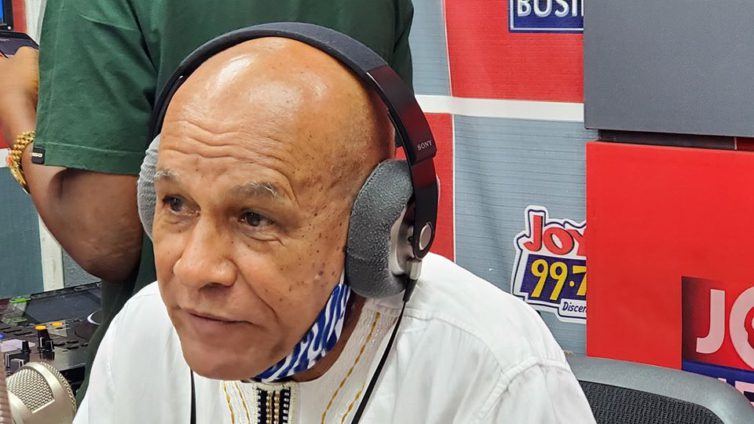
One of West Africa’s most influential radio stations, Joy FM, was born not in a corporate boardroom but during a casual meeting over a shared bowl of fufu, according to veteran broadcaster Tommy Annan-Forson.
Speaking on local television, Annan-Forson recounted how a modest gathering in his living room in the mid-1990s laid the foundation for what would become Ghana’s first private commercial radio station, marking a turning point in the country’s media landscape.
At the time, Ghana’s airwaves were dominated by the state-owned Ghana Broadcasting Corporation, and the concept of private radio seemed uncertain under the government of Jerry John Rawlings.
“We heard there was going to be private radio springing up, but it was hard to believe,” Annan-Forson said, reflecting on the skepticism that surrounded the idea.
The breakthrough came when Kwasi Twum, CEO of Multimedia Group Limited, approached him with an offer to join the new venture.
Leaving behind a stable career at GBC was a gamble. “It was a secure government job. This was something completely new,” he said. “But I decided to take the risk.”
The early days of Joy FM were defined by simplicity and ambition. According to Annan-Forson, the station’s entire programming concept was developed by just three people, himself, Twum, and a colleague, during informal sessions at his home.
“Every single program initiated on Joy FM was conceived in my living room over a bowl of fufu,” he said.
That grassroots approach would later shape the station’s identity—innovative, listener-focused, and independent.
Annan-Forson resigned from GBC on April 30, 1995, and by the next morning was already on air as Joy FM began test transmissions. Early listeners were initially unsure whether the signal was a new GBC frequency or something entirely different.
Once clarified, the station quickly gained traction, becoming a pioneer in Ghana’s emerging private media space.
He credited much of the station’s early success to the editorial freedom granted by Twum. “He gave me the green light to do what I thought was best,” Annan-Forson said, noting that the trust allowed creativity to flourish.
Over time, Joy FM became a launchpad for some of Ghana’s most prominent media figures, including Komla Dumor, Doreen Andoh, and Mark Okraku-Mantey.
The station later moved to Kokomlemle in Accra, where it introduced flagship programs such as the widely followed morning show, helping to redefine radio broadcasting standards in the country.
The transition was not without controversy. Annan-Forson recalled being labeled a “traitor” by former colleagues when he returned to GBC to collect personal belongings.
But the risk paid off. Joy FM’s rapid rise helped catalyze the liberalization of Ghana’s airwaves, paving the way for a vibrant private media sector that continues to expand today.
Three decades on, the story of Joy FM’s origins remains a testament to the power of innovation—and humble beginnings.
“It was an experience worth leaving a job for,” Annan-Forson said. “I’m proud to be part of that story. And to think it all started over a simple bowl of fufu.”