
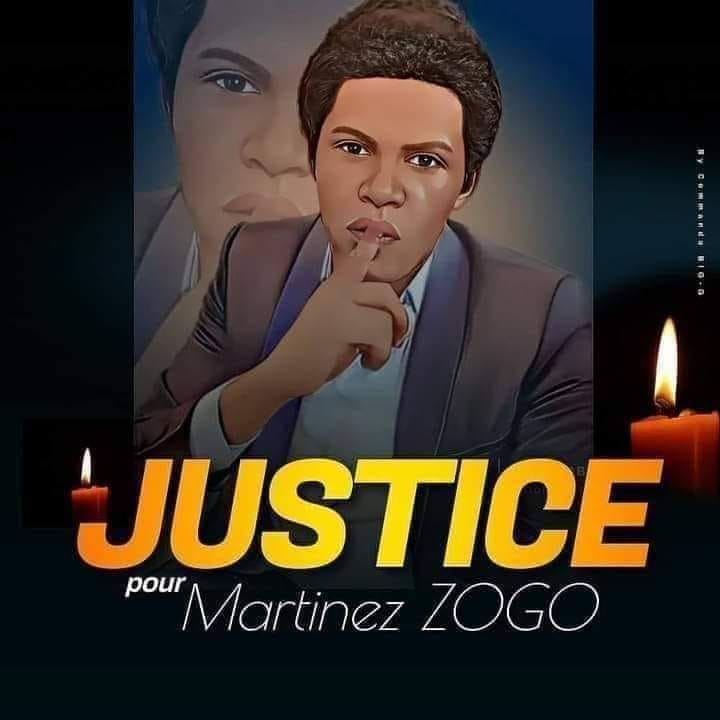
Three years after the abduction, torture and killing of outspoken Cameroonian radio host Martinez Zogo, the legal process meant to deliver justice remains slow, contested and incomplete, leaving his family, colleagues and press freedom advocates in prolonged anguish.
January 17 marks the anniversary of Zogo’s disappearance, while January 22 recalls the grim discovery in 2023 of his mutilated, naked body in a vacant lot on the outskirts of Yaoundé. Zogo, 51, whose real name was Arsène Salomon Mbani Zogo, hosted the popular daily program Embouteillages (“Traffic Jams”) on Amplitude FM, where he fiercely denounced corruption and abuses by powerful figures, while sparing President Paul Biya from criticism.
On the third anniversary of his death, Zogo’s widow, Diane Zogo, joined prayers at a church in Yaoundé’s Etoudi district, calling for justice she no longer expects from the courts.
“May the true assassins of Martinez be punished for what they did,” she said. “But I do not believe in human justice. I believe in divine justice. We cannot mourn while the body is still sealed.”
Zogo’s remains are still impounded as evidence, preventing his family from holding a burial. At Amplitude FM, a banner bearing his image hangs at the station’s entrance, while the memorial chapel set up in the lobby the day after his death remains untouched, a symbol of grief frozen in time.
His former colleagues expressed growing frustration over the pace of the trial.
“Three years later, nothing is happening,” said Charly Tchouemo, editor-in-chief of Amplitude FM. “Frankly, we really don’t know if there will be a logical outcome to this trial.”
The case has nevertheless exposed troubling details about the circumstances of Zogo’s death. According to testimony heard so far, Zogo was under surveillance and wiretapping by members of Cameroon’s General Directorate of External Research (DGRE), the country’s foreign intelligence service. Several DGRE agents have admitted to abducting him outside any legal framework, claiming they were acting on orders meant to intimidate the journalist.
Investigators have established that Zogo was subjected to extreme acts of torture at a location different from where his body was eventually found.
“For the first time, things are becoming clearer,” said Christophe Bobiokono, co-director of publication of the legal weekly Kalara. “Even if, in the end, the DGRE as an institution may bear responsibility, individuals appear to have acted by bypassing the service’s operating rules.”
The trial is taking place before the military court in Yaoundé. It formally opened on March 24, 2024, but substantive hearings only began in September 2025 after months of procedural disputes. The next session is scheduled for January 26.
The government commissioner has announced plans to hear more than 40 witnesses to reconstruct the events surrounding Zogo’s abduction, torture and death. So far, 18 witnesses have testified.
Seventeen defendants are on trial, including former DGRE director Léopold Maxime Eko Eko, influential businessman Jean-Pierre Amougou Belinga, and Martin Savom, who was mayor of Bibey at the time of the events. Despite the high-profile nature of the case, key questions remain unanswered: who ordered the attack, what the precise motive was, and the extent of each defendant’s responsibility.
With hearings held only two days every three weeks, several parties to the case have denounced what they describe as an intentionally sluggish process.
For press freedom advocates, the trial has yet to deliver meaningful accountability.
“Even if legal proceedings are underway and some suspects are tried, full accountability and transparent justice remain out of reach,” said Angela Quintal, Africa director of the Committee to Protect Journalists (CPJ).
She noted that Zogo’s case echoes another unresolved crime against the media. “The anniversary of Zogo’s murder is a stark reminder that the perpetrators of the 2019 killing of journalist Samuel Wazizi are still at large, while his family continues to be denied justice and even the repatriation of his remains.”
As Cameroon marks three years since Martinez Zogo’s death, the slow march of justice continues to cast a chilling shadow over journalists, reinforcing fears about the risks of reporting on sensitive issues, and raising doubts about whether the truth will ever be fully uncovered.