
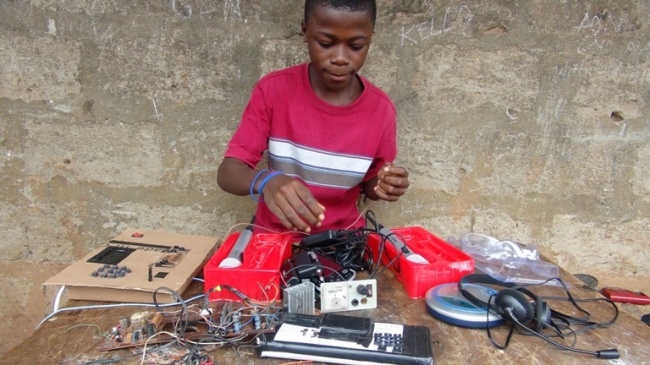
16-year-old self-taught inventor from Freetown, Sierra Leone, has won a prestigious national innovation competition after successfully building an operational FM radio transmitter and generator from salvaged scrap metal and homemade batteries.
Kelvin Doe, a student at the Albert Academy in Freetown, was selected alongside two classmates as one of the winners of the inaugural Innovate Salone competition. The initiative, organized by the non-profit group Global Minimum (Gmin) and supported by the Massachusetts Institute of Technology (MIT), challenges high school students across Sierra Leone to design local solutions to infrastructure, energy, and media challenges.
Doe’s team beat out more than 300 entries from across the country, securing a spot as one of eight winning finalist teams. As a result of his breakthrough work in broadcast engineering, Doe has traveled to New York to present his prototypes at the World Maker Faire and has been appointed as a resident practitioner with the MIT International Development program.
Doe’s journey into radio engineering began at age 10 when he started collecting discarded electronic parts from trash bins in Freetown to build a localized FM transmitter. Driven by a lack of reliable electricity and the high cost of retail consumer goods, he began manufacturing his own operational batteries at age 13 using a mixture of acid, salvaged metal, and baking soda.
He subsequently scaled up his designs to build a custom 12-volt generator to power his entire broadcast setup, which now includes a homemade audio mixer, an amplifier, and the core FM transmitter.
“I made the FM radio station to give a voice to the youth in my community,” Doe explained, noting that he also uses the equipment to pursue his passion for DJing under the moniker ‘DJ Focus.’
The Innovate Salone competition, co-founded by Sierra Leonean MIT Media Lab engineer David Sengeh, provides up to $1,500 in seed funding to student teams targeting advancements in engineering, telecommunications, civic media, and health.
The competition has highlighted a significant interest in radio development among the country’s youth. Out of the eight winning projects, two focused explicitly on the medium, including a localized radio programming initiative designed by students at the Bo School, alongside the Albert Academy’s hardware project.
The success of the broadcast prototypes demonstrates the vital role that community radio continues to play in West Africa, while showcasing how grassroots, low-cost engineering can expand media access and development across the continent.